



AI in SEO: Smart Opportunity or Risk?









AI in SEO: Smart Opportunity or Risk?
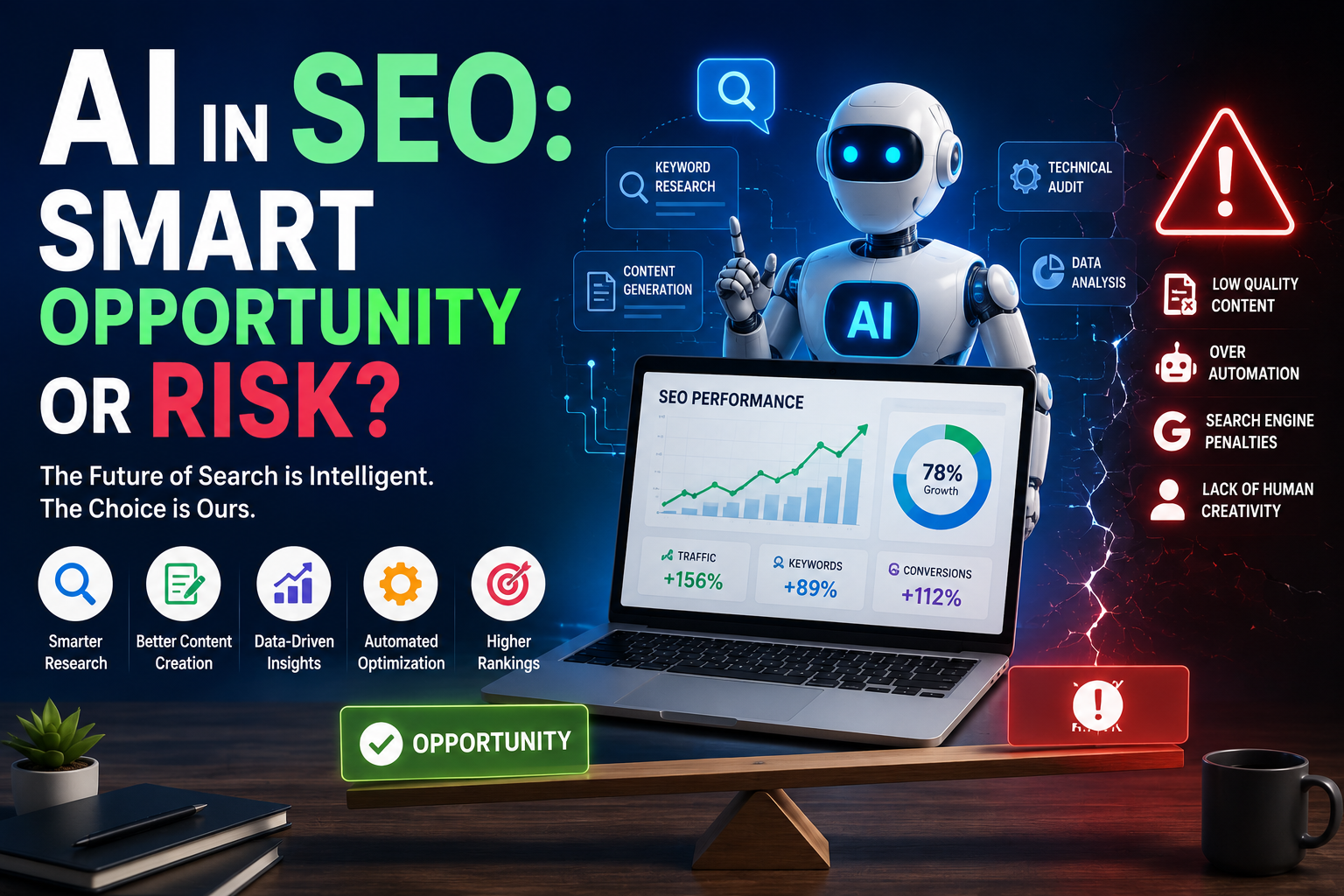
Artificial Intelligence (AI) is transforming digital marketing, and SEO is one of the areas experiencing the biggest shift. From keyword research and content creation to technical audits and performance analysis, AI-powered tools are making SEO faster and more efficient than ever before. But while AI offers exciting opportunities, it also raises concerns about quality, authenticity, and long-term search performance.
So, is AI in SEO a smart opportunity or a potential risk? The answer lies in how businesses choose to use it.
The Smart Opportunities of AI in SEO
1. Faster Keyword Research
Keyword research is the foundation of any successful SEO strategy, and AI makes this process much quicker.
AI tools can:
- Identify trending keywords
- Analyze search intent
- Suggest related keyword opportunities
- Group keywords by topic clusters
This helps marketers save time while building stronger SEO strategies.
Benefit: Faster research leads to quicker implementation and better planning.
2. Smarter Content Creation
AI writing tools can assist in generating blog outlines, content ideas, FAQs, meta descriptions, and draft content.
For businesses that need consistent publishing, AI can reduce content production time significantly.
However, human editing remains essential for originality, tone, and brand messaging.
Benefit: Increased productivity and faster content workflows.
3. Better Technical SEO Analysis
AI-powered SEO platforms can detect technical website issues quickly, including:
- Broken links
- Duplicate content
- Missing metadata
- Crawl errors
- Slow-loading pages
Instead of manually checking every issue, AI helps automate the process.
Benefit: Faster website optimization and improved performance.
4. Improved User Intent Understanding
Modern search engines focus heavily on user intent, not just keywords.
AI tools help analyze whether users are looking for:
- Information
- Products
- Comparisons
- Services
- Solutions
This helps businesses create content that matches what users actually want.
Benefit: Better rankings through more relevant content.
5. Data Analysis and Performance Insights
SEO generates large amounts of data that can be difficult to interpret manually.
AI helps identify:
- Ranking trends
- Traffic patterns
- Conversion opportunities
- Underperforming pages
- Competitor gaps
This makes SEO decision-making smarter and more data-driven.
Benefit: Better optimization strategies based on real insights.
The Risks of AI in SEO
1. Low-Quality Content Problems
One of the biggest risks is over-reliance on AI-generated content.
AI can produce readable text quickly, but it may:
- Repeat generic information
- Lack originality
- Miss brand voice
- Provide inaccurate details
Search engines prioritize helpful and valuable content, not mass-produced text.
Risk: Poor content can damage rankings and user trust.
2. Duplicate or Similar Content
AI tools often generate content based on existing online patterns.
This increases the chance of creating content that feels repetitive or too similar to competitors.
Unique content is essential for strong SEO performance.
Risk: Reduced differentiation and weaker rankings.
3. Search Engine Compliance Concerns
Search engines reward high-quality content regardless of how it’s created, but manipulative or spammy AI-generated content can be penalized.
Using AI purely to flood websites with low-value pages creates risk.
Risk: Potential ranking drops if quality standards are ignored.
4. Lack of Human Creativity
SEO is not just about optimization—it’s also about storytelling, emotional connection, and understanding customer psychology.
AI struggles with:
- Brand personality
- Creative campaigns
- Original thought leadership
- Cultural nuance
Human creativity remains irreplaceable.
Risk: Generic content that fails to connect.
5. Dependence on Automation
Relying entirely on AI can weaken strategic thinking.
SEO requires:
- Market understanding
- Competitor analysis
- Brand positioning
- Long-term planning
AI should support experts, not replace decision-making.
Risk: Poor strategy caused by automation dependency.
Smart Way to Use AI in SEO
The best approach is using AI as an assistant, not a replacement.
Use AI for:
Research
Content ideas
Technical audits
Data analysis Workflow automation
Use humans for:
Strategy
Creativity
Editing
Brand voice
Final decision-making
This balanced approach delivers efficiency without sacrificing quality.
Final Thoughts
AI in SEO is both a smart opportunity and a potential risk.
When used responsibly, AI can save time, improve efficiency, and strengthen SEO performance. But relying on it blindly can create low-quality content, strategic mistakes, and ranking problems.
The future of SEO is not AI versus humans—it’s AI working alongside human expertise to create smarter, stronger digital marketing strategies.