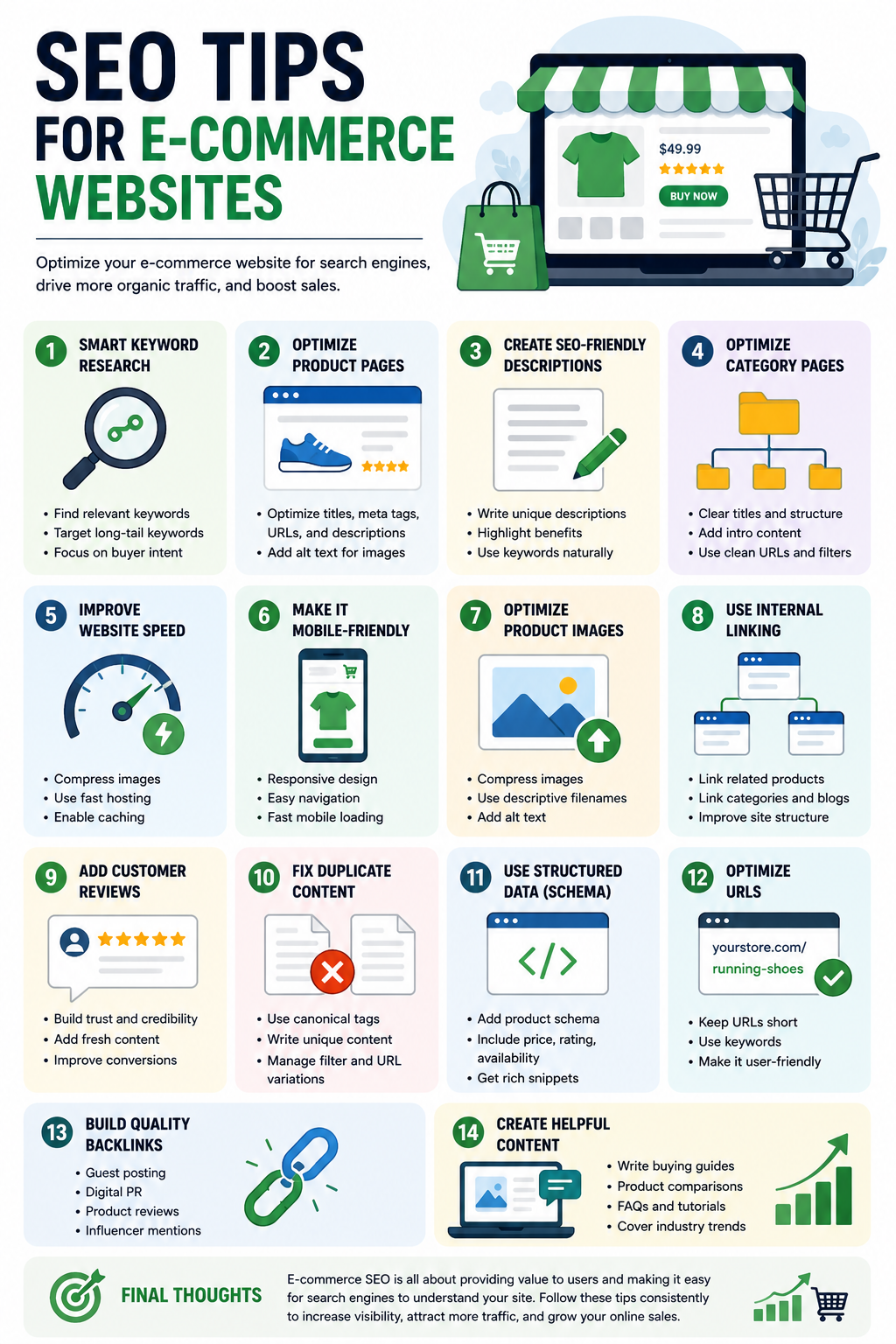
SEO Tips for E-commerce Websites

Running an e-commerce website is not just about listing products—it’s about making sure customers can actually find them. With thousands of online stores competing for attention, SEO (Search Engine Optimization) plays a major role in driving organic traffic, increasing visibility, and boosting sales. A strong SEO strategy helps your e-commerce store rank higher on search engines and attract shoppers who are actively looking for your products.

Here are practical SEO tips for e-commerce websites.

1. Perform Smart Keyword Research

Keyword research is the foundation of e-commerce SEO.

Focus on:

  • Product-specific keywords
  • Category keywords
  • Long-tail keywords
  • Buyer-intent search terms

Examples:

  • Men’s running shoes online
  • Best skincare products for dry skin
  • Affordable wireless earbuds

Target keywords that match purchase intent.

2. Optimize Product Pages

Product pages are critical for rankings and conversions.

Optimize:

  • Product titles
  • Product descriptions
  • Meta titles
  • Meta descriptions
  • URLs
  • Image alt text

Avoid copying manufacturer descriptions—unique content performs better.

3. Create SEO-Friendly Product Descriptions

Write original descriptions that:

  • Highlight product benefits
  • Include keywords naturally
  • Answer common questions
  • Improve readability

Good content helps both rankings and conversions.

4. Optimize Category Pages

Category pages often target competitive keywords.

Best practices:

  • Clear category titles
  • Helpful intro content
  • Optimized metadata
  • User-friendly filters
  • Clean URLs

Strong category pages improve navigation and SEO visibility.

5. Improve Website Speed

Speed directly impacts SEO and sales.

Slow websites increase bounce rates and cart abandonment.

Improve speed by:

  • Compressing images
  • Using fast hosting
  • Reducing unnecessary scripts
  • Enabling caching
  • Optimizing code

Fast websites convert better.

6. Make Your Website Mobile-Friendly

Many e-commerce purchases happen on mobile devices.

Ensure:

  • Responsive design
  • Easy product browsing
  • Simple checkout process
  • Readable content
  • Fast mobile loading

Mobile SEO is essential.

7. Optimize Product Images

Images improve shopping experience but can hurt speed if poorly optimized.

Best practices:

  • Compress image sizes
  • Use descriptive filenames
  • Add alt text
  • Use high-quality but lightweight images

Image SEO can also drive traffic from image search.

8. Use Internal Linking Strategically

Internal links help search engines understand site structure.

Examples:

  • Product to related products
  • Product to category pages
  • Blogs to product pages
  • Category to buying guides

This improves crawlability and user navigation.

9. Add Customer Reviews

Reviews help SEO by adding fresh content and improving trust.

Benefits:

  • Better user engagement
  • More keyword variety
  • Higher conversion rates
  • Stronger product credibility

User-generated content adds SEO value.

10. Fix Duplicate Content Issues

E-commerce sites often face duplicate content from:

  • Similar product pages
  • Filter URLs
  • Manufacturer descriptions

Use:

  • Canonical tags
  • Unique content
  • URL management

Duplicate content can confuse search engines.

11. Use Structured Data (Schema Markup)

Schema helps search engines understand product information.

Useful schema includes:

  • Product pricing
  • Ratings
  • Availability
  • Reviews

This can improve search appearance with rich snippets.

12. Optimize URLs

Keep URLs:

  • Short
  • Clear
  • Keyword-friendly
  • Easy to understand

Example:
Good: yourstore.com/mens-running-shoes
Bad: yourstore.com/product?id=12345xyz

13. Build Quality Backlinks

Backlinks improve authority.

Safe ways:

  • Guest posting
  • Digital PR
  • Product reviews
  • Influencer mentions
  • Shareable guides

Avoid spammy shortcuts.

14. Create Helpful Content

Content marketing supports e-commerce SEO.

Examples:

  • Buying guides
  • Product comparisons
  • FAQs
  • Tutorials
  • Trend articles

Content attracts top-of-funnel traffic.

Final Thoughts

E-commerce SEO requires both technical optimization and user-focused strategy.

By improving product pages, speeding up your website, optimizing for mobile, fixing duplicate content, and creating valuable content, your online store can attract more organic traffic and increase sales.

Strong SEO turns your e-commerce website into a long-term growth engine.