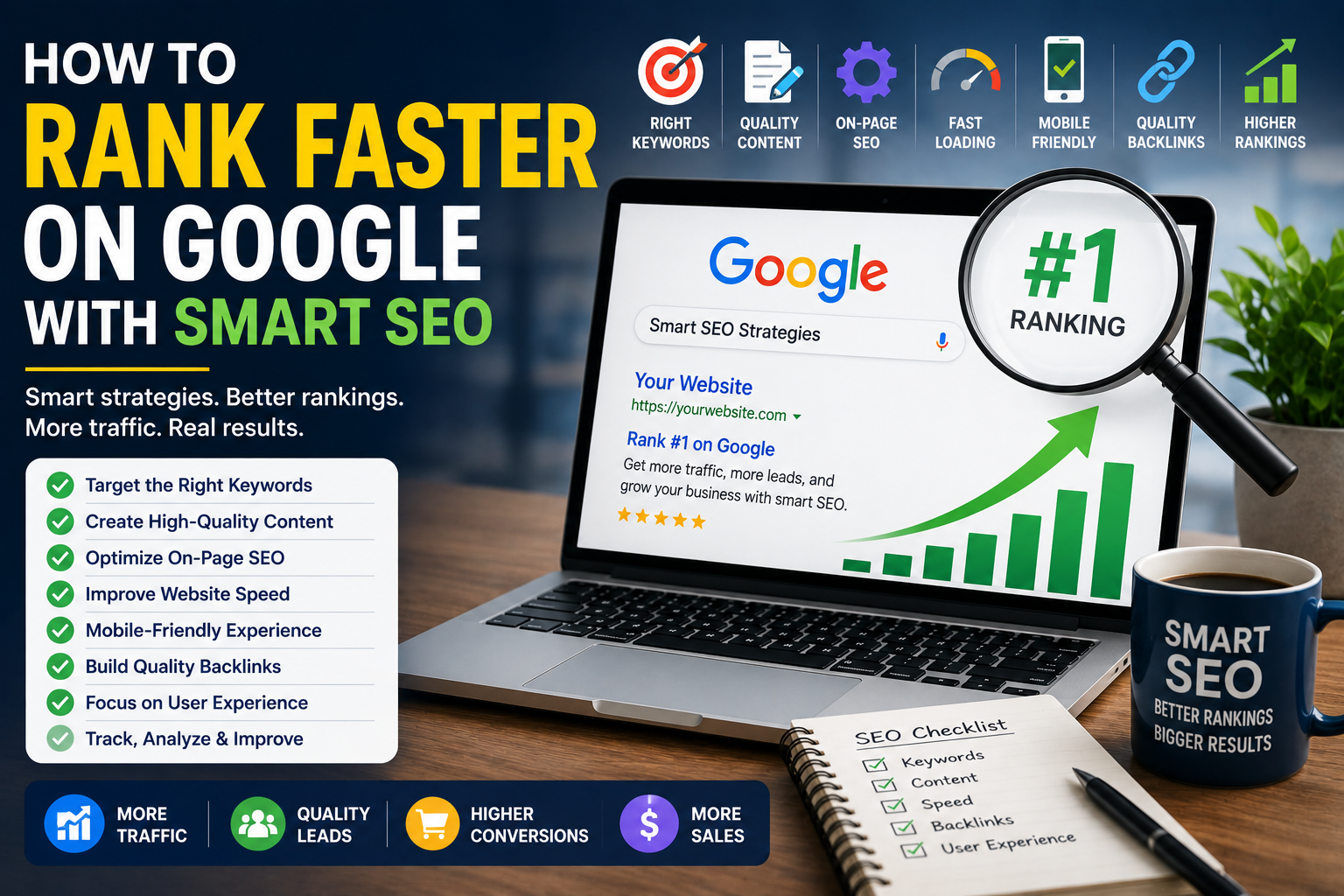
 Ranking on Google is a top priority for businesses looking to increase online visibility, attract website traffic, and generate quality leads. However, SEO is often seen as a slow process. While long-term consistency is essential, smart SEO strategies can help you achieve faster results without relying on shortcuts or risky tactics.
The key is focusing on methods that improve relevance, authority, and user experience. Here’s how to rank faster on Google using smart SEO techniques.
1. Start with Strategic Keyword Research
Fast SEO growth begins with targeting the right keywords.
Instead of competing immediately for highly competitive broad terms, focus on long-tail keywords with strong search intent and lower competition.
Examples:
- “best SEO agency for startups”
- “affordable digital marketing services in Delhi”
- “how to improve website traffic quickly”
These keywords are easier to rank for and often attract users ready to take action.
Why it works: Less competition means quicker ranking opportunities.
2. Create High-Quality, Search-Focused Content
Google prioritizes content that solves user problems clearly and effectively.
Your content should be:
- Original
- Helpful
- Well-structured
- Easy to read
- Updated regularly
Focus on answering real user questions better than competitors.
Include:
- Clear headings
- Practical examples
- FAQs
- Visual elements
- Actionable advice
Why it works: Better content improves engagement and rankings.
3. Optimize On-Page SEO Properly
Even great content needs technical optimization.
Important on-page elements:
- Keyword-rich title tags
- Meta descriptions
- Header tags (H1, H2, H3)
- Internal linking
- Image alt text
- Clean URLs
Example:
Instead of:
website.com/page123
Use:
website.com/smart-seo-ranking-tips
Why it works: Helps Google understand and index your content faster.
4. Improve Website Speed
A slow website hurts both rankings and user experience.
Speed optimization tips:
- Compress images
- Minimize code
- Remove unnecessary plugins
- Use quality hosting
- Enable browser caching
Visitors leave slow websites quickly, increasing bounce rates.
Why it works: Faster websites perform better in search rankings.
5. Make Your Website Mobile-Friendly
Google uses mobile-first indexing, meaning your mobile website experience matters heavily.
Your website should:
- Load quickly on mobile
- Be easy to navigate
- Display properly across devices
- Have readable text and accessible buttons
Why it works: Better mobile usability improves ranking potential.
6. Build Internal Links Strategically
Internal links connect related content across your website.
Benefits:
- Helps Google discover pages faster
- Improves site structure
- Increases time spent on site
- Distributes page authority
Example:
A blog about SEO mistakes can link to a guide on keyword research.
Why it works: Faster indexing and stronger content relationships.
7. Target Featured Snippets
Featured snippets can help you gain visibility quickly.
To optimize:
- Answer questions directly
- Use bullet points
- Add FAQ sections
- Write concise definitions
- Structure content clearly
Example query:
“What is smart SEO?”
Provide a short, direct answer near the top.
Why it works: Featured snippets can dramatically increase clicks.
8. Earn Quality Backlinks
Backlinks remain one of Google’s strongest ranking signals.
Smart ways to earn them:
- Guest posting
- Digital PR
- Shareable content
- Industry partnerships
- Resource guides
Avoid spammy backlink schemes.
Why it works: Quality backlinks improve authority faster.
9. Optimize for Local SEO (If Relevant)
For local businesses, ranking faster often depends on local optimization.
Key steps:
- Optimize Google Business Profile
- Collect customer reviews
- Use location-based keywords
- Maintain consistent contact details
Example:
“best salon in Gurgaon”
Why it works: Local competition is often easier to outperform.
10. Track Performance and Improve Continuously
SEO success requires regular analysis.
Monitor:
- Keyword rankings
- Organic traffic
- Bounce rates
- Click-through rates
- Conversion performance
Update underperforming pages instead of ignoring them.
Why it works: Continuous improvements accelerate growth.
11. Use Smart Technical SEO Practices
Technical SEO helps search engines crawl your site efficiently.
Important steps:
- Submit XML sitemap
- Fix broken links
- Eliminate duplicate content
- Improve crawlability
- Use HTTPS security
Why it works: Better indexing leads to faster visibility.
Final Thoughts
Ranking faster on Google doesn’t mean using shortcuts—it means using smarter SEO strategies.
By combining targeted keywords, valuable content, technical optimization, strong user experience, and authority-building tactics, businesses can accelerate their SEO growth responsibly.
Smart SEO is about working strategically, consistently, and always focusing on what users—and search engines—value most.