



Performance Marketing Explained for Beginners









Performance Marketing Explained for Beginners
 Performance Marketing Explained for Beginners
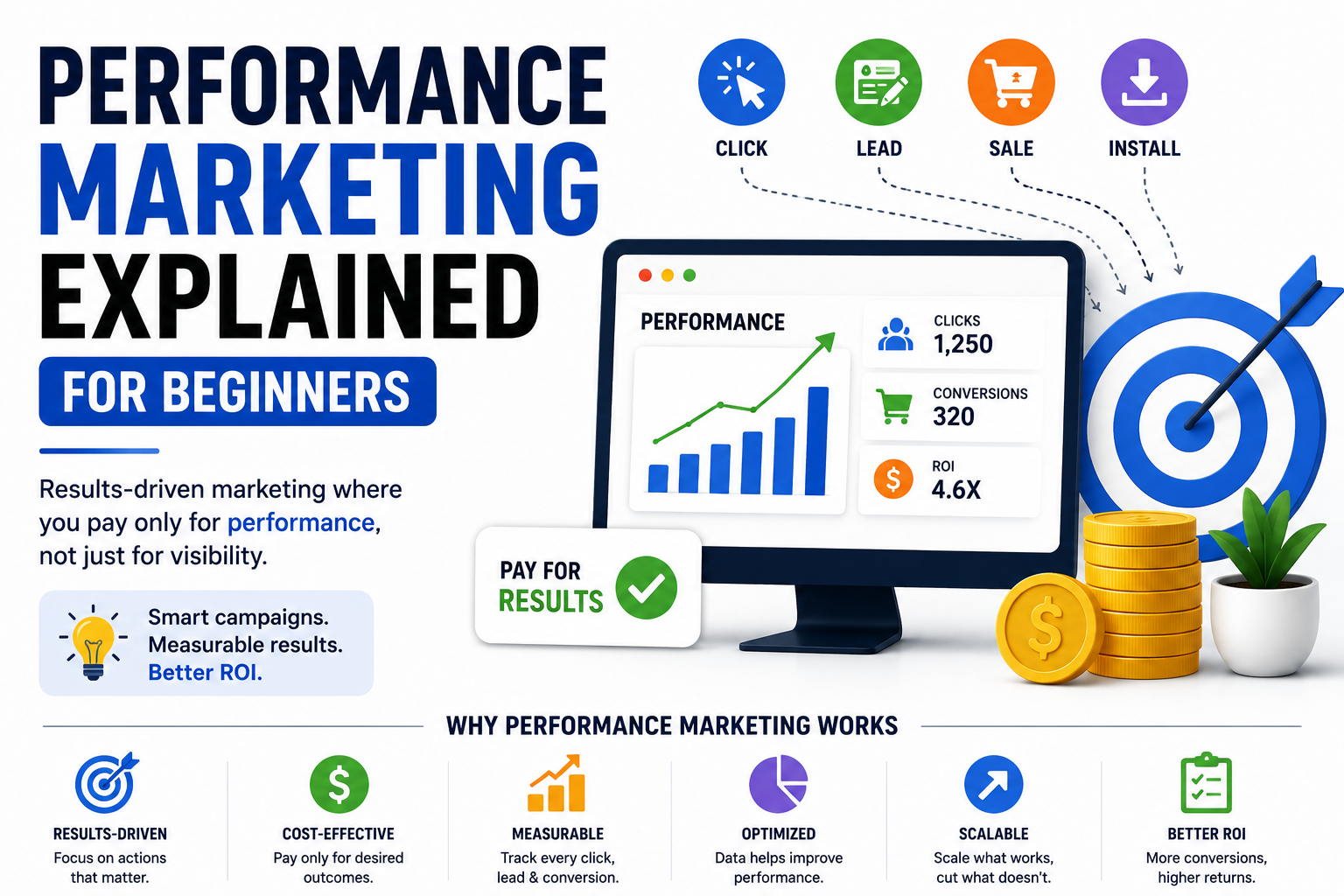
In today’s digital marketing world, businesses want measurable results from every rupee they spend. That’s where performance marketing comes in. Unlike traditional advertising, where brands often pay upfront without guaranteed outcomes, performance marketing focuses on results. You pay based on specific actions such as clicks, leads, conversions, or sales.
For beginners, performance marketing may sound complex, but the concept is simple: marketing where performance determines the cost.
Let’s break it down.
What is Performance Marketing?
Performance marketing is a digital marketing strategy where advertisers only pay when a desired action occurs.
These actions can include:
- Website clicks
- Lead generation
- App installs
- Product purchases
- Form submissions
- Sales conversions
Instead of paying just for ad visibility, businesses invest in campaigns designed to deliver measurable outcomes.
Example:
If you run a Facebook ad campaign and pay only when users click your ad or complete a purchase, that’s performance marketing.
Why Performance Marketing Matters
Modern businesses need marketing that is:
- Trackable
- Cost-efficient
- Scalable
- Results-driven
Performance marketing provides clear data on what works and what doesn’t.
Benefits include:
- Better budget control
- Measurable ROI
- Faster campaign optimization
- Lower wasted spending
- Improved decision-making
This makes it highly attractive for startups, small businesses, and growing brands.
How Performance Marketing Works
The process usually follows this structure:
1. Create a campaign
Design ads with a clear goal.
2. Target the right audience
Reach users likely to convert.
3. Track performance
Measure clicks, leads, purchases, or conversions.
4. Optimize continuously
Improve campaigns based on results.
5. Scale successful campaigns
Increase budget for top-performing ads.
Everything is data-driven.
Common Performance Marketing Channels
1. Search Advertising
Platforms like Google Ads allow businesses to target users actively searching for products or services.
Example:
A user searches:
“best digital marketing agency near me”
Your ad appears.
This is highly intent-driven marketing.
2. Social Media Advertising
Platforms include:
- TikTok
- X (Twitter)
Social ads target users based on interests, demographics, and behavior.
Best for:
- Brand awareness
- Lead generation
- E-commerce sales
3. Affiliate Marketing
Businesses partner with publishers or influencers who promote products.
Payment happens only when performance occurs (sale, lead, click).
Example:
A blogger earns commission for generating product sales.
4. Display Advertising
Visual banner ads shown across websites and apps.
Often used for:
- Awareness
- Retargeting
- Brand recall
5. Email Marketing (Performance-Based)
Email campaigns measured through:
- Open rates
- Click rates
- Conversions
- Revenue
Important Performance Marketing Metrics
Beginners should understand key metrics:
CPC (Cost Per Click):
Amount paid for each click.
CPA (Cost Per Acquisition):
Cost to acquire one customer.
CTR (Click-Through Rate):
Percentage of people who click after seeing the ad.
ROAS (Return on Ad Spend):
Revenue earned compared to ad spending.
Conversion Rate:
Percentage of visitors who complete the desired action.
These metrics help evaluate campaign success.
Performance Marketing vs Traditional Marketing
| Traditional Marketing | Performance Marketing |
|---|---|
| Less measurable | Highly measurable |
| Fixed upfront costs | Pay for results |
| Harder to optimize | Easy to optimize |
| Broader targeting | Precision targeting |
| Slower feedback | Real-time insights |
Performance marketing gives businesses greater control.
Common Beginner Mistakes
New marketers often make mistakes like:
- Targeting broad audiences
- Ignoring conversion tracking
- Weak ad creatives
- Poor landing pages
- Not testing campaigns
- Scaling too quickly
Performance marketing rewards constant optimization.
Tips for Beginners
If you’re starting out:
✔ Begin with a clear objective
✔ Choose one platform first
✔ Set a realistic budget
✔ Install proper tracking tools
✔ Test creatives regularly
✔ Optimize based on data
✔ Learn audience behavior
Start simple, then scale.
Final Thoughts
Performance marketing is one of the most effective digital marketing strategies for businesses that want measurable growth.
Because every click, lead, and sale can be tracked, businesses gain better control over spending and ROI.
For beginners, the biggest advantage is clarity—you can see exactly what works and improve continuously.
In simple terms, performance marketing is not about spending more money—it’s about spending smarter for real results.